

Greetings – – –
I have a new humorous essay, “Missing Cat,” in the latest issue of Chapter 16. It’s all about the time my beloved Tummywumps went missing. Have a look.
How have you been?
Cheers – – –

Greetings – – –
I have a new humorous essay, “Missing Cat,” in the latest issue of Chapter 16. It’s all about the time my beloved Tummywumps went missing. Have a look.
How have you been?
Cheers – – –

“I was walking my coffee in a terrifying neighborhood…”
Take a peek at my latest humorous essay, “Search Party.“
Something was missing from my life.
It was gin.
The cashier put the gin in the bag. She tried sticking something else into it.
“Wait — what’s that?” I said. “I didn’t buy that.”
“Oh, this? This is my book.”
She handed it to me. Before I could stop her.
The title of the book was Murder Starts with M.
Alice slid the dagger gingerly into Georgina’s back. That was the first line.
“What do you think?”
“It’s…”
“Were you going to say ‘good’?”
I nodded. Reluctantly.
“Really? Do you really think it’s good?”
She was quivering.
“Sure,” I said.
The cashier cried a little. She looked like she might blow up.
She stuck the book back in the bag.
There was a trashcan outside the liquor store. An old man was picking through it.
I threw the book in the trashcan. The man grabbed it. He opened it.
“A pool of lipstick-red blood spread across the off-white carpet like a shallow swimming pool,” he said.
The old man closed the book. He threw it back in the trash.
I noticed something peculiar on the bus. I always do.
A smiling guy was breathing heavily. He reached into his jacket pocket and pulled out a book. There was a gun on the cover.
“I’m a writer,” he said to the passenger next to him.
The woman slid over. She reached into her purse.
“I’m a writer too,” she said, waving a paperback.
The bus driver stood up. He opened a book — and his mouth:
“And the waves rolled on and the storm rolled, and Miguel rolled out of bed and rolled a cigarette and helped himself to some hot buttered rolls.”
The bus crashed into a bookstore. Luckily, it was empty.
Not everyone survived. The writers that survived started eating the dead ones.
That was the peculiar thing.
I was just a few blocks from home. The gin was getting heavy.
I heard screams.
A girl was lying in the street. A bunch of those things were on top of her. Smothering her with books.
All I had on me was the gin.
I drank the gin. I smashed the end off the empty bottle and charged at the things.
They staggered back.
I grabbed the girl’s hand. I lifted her up.
An old guy who looked like Norman Mailer tugged on her purse, but she pulled it free.
“Come on,” I said.
We ran to my house.
I locked the door and bolted it.
I passed out.
When I woke up, I had a headache. There was a pillow under my head.
I head the fireplace crackling and noticed the doors and windows were boarded up.
“My name’s Madeline,” said the girl, walking into the room with two coffees.
“Did you do all this?”
She smiled.
“My dad’s a lumberjack,” she said.
There was a big pile of novels on the floor.
“What happened to my bookcases?” I asked.
Madeline never quit smiling.
“Right,” I said.
It was incredibly strong coffee. Thank god.
“How old are you?”
“Eighteen,” Madeline answered. “This month.”
The front door burst open.
A dozen writers squeezed through it.
We grabbed the nearest objects at hand, books.
I threw my least favourite books by my favourite authors. I threw Martin Chuzzlewit and Hocus Pocus. I threw Coriolanus and Sylvie and Bruno and Across the River and Into the Trees.
Before I could stop her, Madeline threw both volumes of my Moroccan leather-bound edition of Boswell’s Life of Samuel Johnson. Oh, well.
The writers retreated.
I slammed the door. While I held it shut, Madeline hammered the bookshelves back in place.
“That was close,” she said.
“I need a drink,” I said.
We slept in shifts — on the sofa. Only I couldn’t. Instead, I lay awake listening to the sound of thousands of fingernails running down book spines.
“Madeline?” I said, sitting up. “Did you remember to board up the basement windows?”
“Yes,” she said, flipping the page of her book.
I sighed — and lay back down.
A minute later, I sat back up and said:
“Do you think they might come down the chimney?”
“Not with the fire going, no.”
“Right,” I said. And then I said, “Madeline?”
“Go back to sleep,” was all she said.
I must’ve. I dreamed I was trapped in an alley. Those things were closing in. One lunged ahead of the pack.
“Read,” she said, holding out a book. Vampire Wizards.
“Who published this?” I asked.
“I did,” she said.
I flipped through the book. It was full of grammatical errors.
“Well?”
For once in my life, I told the truth.
“Don’t quit your day job,” I said.
Then the writers piled on top of me and ate my skin.
When I woke up, Madeline was chopping down the kitchen table.
“I reinforced the doors and windows,” she said. “No one’s getting in — or out.”
She laughed.
I laughed.
I made the coffee this time.
The coffee table was missing, too.
Madeline sat by the fire. Her bright side looked beautiful.
“My lips are so dry,” she said, rooting through her purse for something. I hoped it was gin.
Something fell out of her purse. Into the shadows.
She picked it up.
A paperback.
Death Insurance.
By Madeline Brooks.
I jumped up. The coffee cup crashed on the floor.
I tried prying the boards off the windows, doors.
Madeline licked her finger.
My fingers were bleeding.
“Chapter One,” she said. “The Beginning.”
No, I thought. The End.
Rolli’s latest book is Plumstuff. Buy him a coffee.

Hello, Friends – – –
My latest humorous essay, “Dangerous People,” was just published in Chapter 16. You might like it.
Cheers – – –

Rolli’s latest book is Plumstuff. Buy him a coffee.

When Dad died, I talked to an ostrich.
In the waiting room, an ostrich sat down.
“Who let this ostrich in?” I asked.
The janitor stared at me.
The ostrich stared at me.
The surgeon walked into the room. He tore off his white mask and put on a serious one.
“You don’t even have to say it,” I said.
The ostrich put his wing around me.
*
We didn’t have the greatest relationship, Dad and I. We didn’t talk. He treated me like shit. I loved him. I realized that after.
When he got sick, I walked closer to him, sat closer. We still didn’t talk, but…
Then he died.
*
“I could really use a friend,” I said in a letter. I mailed a copy of it to everyone I could think of.
No one got back to me.
One afternoon, there was a knock on the door.
I stepped out of bed. And got dressed.
I opened the door…
It was the ostrich.
He sat down on the sofa.
“I’ll make some coffee,” I said.
*
“I don’t remember Dad ever playing with me. He was always too old. Even when he wasn’t. He loved me. He never said it. I said it a lot when I was a kid, but I didn’t mean it. Not really.”
You can tell an ostrich anything.
*
I couldn’t get out of bed. I couldn’t open my eyes. I kept falling asleep. I kept dreaming.
I dreamed I was the last person on Earth. I felt so homesick. Even though I was home.
I crawled into bed — in my dream. I lay there.
Something touched my hair. Something tousled it. Like Dad used to.
I woke up.
I looked over.
There was something on the pillow next to me.
An ostrich feather.
*
One morning…
I looked out the window.
The sky was blue. I hadn’t noticed that. Not for months.
I made breakfast.
I swept the floor.
As I opened the front door, I saw something. The shadow of the ostrich. On the lawn.
Just the shadow.
Then it was gone.
Rolli’s latest book is Plumstuff. Buy him a coffee.

I couldn’t get out of bed, so I went for a walk.
There weren’t many people in Emergency. An old woman kept rubbing her breast. A sunburned man staggered up to the desk and asked the triage nurse out on a date. She pressed a red button and he vanished. I looked at the button and thought, I could use one of those.
“Have you been drinking?” the nurse asked me.
I was having trouble putting the failure of my life into words.
“Take a seat,” she said at last.
I waited two hours, three hours. The room really filled up.
I hadn’t realized I was wearing mismatched shoes.
After four hours, I got up.
“What are you doing later?” another drunk asked the nurse as I walked out the door.
There’s a beautiful park across from my apartment that’s used mostly for selling drugs and sex. One sex worker pretends to talk on the pay phone in the middle of the park, all day. If a man approaches her, she hangs up. I’ve hardly ever gone past when she wasn’t on the phone.
I walk in the park when I’m depressed because I don’t care about the danger.
“You wanna buy a knife?” asked a voice.
I looked up. A young guy was holding out a hunting knife.
“Okay,” I said.
I pulled out my wallet. The young guy grabbed my wallet and took off.
The sex worker was watching me. I walked up to her. She hung up the phone.
“Did you see that?” I asked her.
She thought for a long time.
“No,” she said.
She picked the receiver back up.
“I love you too, Mom,” I heard her say as I walked away.
The funny thing about depression is that you forget everything that ever mattered to you. Work. Hobbies. Friends. Sex. They all float away from you like helium balloons. For a while, you wonder where they’re going and when they’ll ever come down. Then you just don’t care.
I guess it isn’t that funny.
I couldn’t afford a psychiatrist. A friend recommended a drop-in center where you could talk to volunteers. They weren’t qualified but they were good listeners.
The lady at the front desk looked up at me.
“There’s no one here right now,” she said. “But if you’d like to watch the video, I can put it on.”
I followed her into the Theatre. It was a closet with a television in it. She put a cassette tape into a VCR. I hadn’t seen a cassette tape or a VCR in years. I almost laughed.
“You think it’s hopeless,” said the woman on the screen. “Hopeless. But our love is brighter than a million stars, Gerome.”
“What is this?” I asked.
“It’s therapeutic,” said the woman, on her way out of the Theatre.
“That night in the tower, looking down at the sea… I thought about ending it all. Then, Beverly, I remembered your loveliness.”
After a few minutes, I pressed eject. The label on the tape said:
Melodramas for Depressed Persons, Cassette One
I laughed. I felt a bit better.
It was Friday night. The bars were all busy.
Emergency was busy. The line-up flowed out the door.
“Hey buddy, can you help a guy out?” asked the drunk in front of me.
“I’m a writer,” I said.
He turned back around.
It was after midnight when I finally saw a doctor.
“What’s wrong?” he asked.
I tried explaining.
“Do you hear voices?”
“Just yours,” I said.
The doctor shook his head.
“Do you feel like hurting people? Or yourself?”
I didn’t at the moment.
The doctor sighed.
“Come back when you do,” he said. Then he pressed a white button on the wall and disappeared.
I looked at the button and thought, I could really use one of those.
Pills are unpredictable. Slitting your wrists is barbaric.
I jumped off a bridge.
A lot of people jump off Millennium Bridge. It’s so high that your spine shatters when you hit the water. You don’t have to worry about drowning. I thought that was a plus.
I climbed onto the cement column and looked around.
I had a lot of memories. I just couldn’t remember them.
I looked down at the water.
“What’s up?” asked the policeman. He didn’t get too close.
“I know things seem bad right now, but it’s not as bad as you think.
“Why don’t you come back down?
“Don’t do something you’ll regret.”
I smiled. Maybe I’d regret jumping to my death.
“You’ve got a lot to live for, probably.
“You want to tell me about it?
“Don’t do something you’ll regret.”
I laughed.
I jumped.
I didn’t die. I broke every vertebra, I think, and my left arm. But I paddled with my right arm long enough for the rescuers to get to me. I did it automatically, like a cat. I wasn’t thinking.
I was in the hospital for three months. Since I was there anyway, they gave me medication.
I started to laugh more. When I laughed too much, they lowered my dosage. “It takes a while to get the right balance,” the doctor said.
When they felt I was balanced enough, they gave my clothes back. And sent me home.
“This is the end,” said the woman on Cassette Two, sobbing.
“No,” said the man. “This is the beginning — of a glorious new life of love.”
I laughed. It really was therapeutic.
I was walking in the park one afternoon. Feeling a lot better. I carried a knife now for self-defence.
The sex worker was on the payphone.
I thought, Maybe I was pessimistic. Maybe it was the depression talking. That girl might really be talking to her mother. She just loves her that much.
You never know.
“I’ll be fine, Mom,” I hear her say. As I walked on.
This story was first published (as “Melodramas for Depressed Persons”) in The Saturday Evening Post.
If you enjoyed this story, kindly consider buying me a coffee.
Hello, Friends – – –
As I drank my fifth cup of coffee this morning, I recalled the time New York Magazine interviewed me on the subject of drinking (too much?) coffee. In case you missed it, here’s the link to the interview.
Time for my sixth cup.
Cheers – – –
Rolli

Writers aren’t like other people.
They have less money. Considerably less.
They drink more. Considerably more.
Palely haunting basements/attics as they do, they could easily be mistaken for ghosts. But writers are themselves haunted by one particular phantom. Its name is Rejection.
In my writing lifetime, I’ve received enough rejection letters, easily, to fashion the paper-boat twin of the RMS Titanic. I picture it filled to the brim with editors, floating noisily into icy northern waters.
I once received eleven rejection slips in a single day. What happened the rest of the day is, with a little help from gin, a mystery.
And I remember — how could I forget — the very first time my work was rejected. That first cosmic shin-kicking.
I was a longhaired eighteen-year-old, teeming with optimism.
The hair is gone, now, along with the optimism. But my recollection is as sharp as ever…
*
Like most unimpressive youths with no notion of how or what to write, my first composition was a poem.
My own life, I figured, was too dull to write about (it was), and so for source material I browsed bookstores (they still had bookstores in those days) and libraries (there were still a few libraries) and even newspapers (there were two of them).
Chancing, at last, on an inspiring idea, I closed myself off from the world and labored for days on a poem that was, in my humble estimation, the best ever written.
It was a ballad. A lengthy one. About an ornery sea captain.
Hoarding brilliance is criminal — sea-captain ballads belong to us all — so I stuffed the poem into an envelope addressed to The Biggest New York City Magazine, dropped it in a mailbox, and waited.
And waited…
While I waited, I daydreamed. Mostly about the Literary World, which I envisioned as a green lawn strewn with tapas tables and who’s whos.
SCENE: A garden party. Assembled LITERATI yammer over crab puffs. Enter the AUTHOR, a gallant youth wearing a bowtie and gripping an orné cane. A hush comes over the crowd. A MONACLED MAN approaches the AUTHOR.
MONACLED MAN [Timidly.] I beg your pardon. But aren’t you the celebrated author of “The Ornery Sea-Captain?”
The AUTHOR swallows a crab puff, adjusts his bowtie, and gives his cane a flourishing twirl.
AUTHOR: [Dryly.] Yes.
The LITERATI pour forth in a din of crinoline-swish and cane-clatter, a thousand jewelled hands reaching out for the AUTHOR’S, which are full of crab puffs.
It was a glorious vision.
As the weeks of waiting became months, I revisited that fantasy again and again. Sometimes I’d be wearing a top hat, and sometimes a beret, but otherwise it played out identically. Until, one morning…
Rummaging through the day’s hamburger adverts, I discovered a letter from The Biggest New York City Magazine.
I secreted the envelope back to my suite. As the LITERATI peered over my shoulder, I tore it open. And stood there, perplexed.
The envelope contained my original poem and — not a check, but a scrap of paper with a few lines printed on it. I remember the lines verbatim not because they stung (and they did sting) but because, in the ensuing years, I’ve received identically worded notes a million additional times, at least.
Dear Author:
We regret that we are unable to use the enclosed material.
Yours,
The Editors
That was it.
The MONACLED MAN lifted his chin and laughed derisively. As he and his associates polished off the crab puffs, the green lawns receded into the dusty floor of my unswept apartment.
I crumpled up the rejection slip, disheartened. Then it occurred to me — administrative glitches are inevitable — that it may have been sent in error. With renewed enthusiasm, I launched the Captain back to New York City.
The Captain sailed straight home, in record time.
At best semi-fazed, I tried my luck with The Second-Biggest New York City Magazine.
Then The Third-Biggest.
The Fourth.
And every time, the Captain faithfully returned, puffing on his corn pipe, shrugging. It was devastating.
I was — devastated.
I contemplated scaling a lighthouse and flinging myself into the sea.
I lived in the middle of the Canadian prairies.
But there are other ways of drowning oneself. As every writer knows.
I reached for the gin bottle…
*
It took me years to have a trio of critical epiphanies.
The first: “The Ornery Sea-Captain” was an atrocious poem. In fact, everything I wrote in those days was atrocious. Writing something worth reading takes years of rehearsal. I’m still working on it, actually.
The second: There really is a garden. A beautiful one, full of actual LITERATI and actual AUTHORS eating crab puffs, drinking wine and laughing uproariously. What I hadn’t noticed, though, in my youthful fantasizing, were the high walls surrounding the garden, and its oppressive iron door. Submitting one’s work — whether to a magazine or a publishing house — is like approaching that door and taking a random stab at the password. You might get it, eventually. If you’re extraordinarily lucky. And you might die trying, too.
The third realization: if you purchase the really big bottles, you can save hundreds of dollars a year on gin.
*
I’ve still never been published in The Biggest New York City Magazine. Or The Second-Biggest. Or The Third. Though I still submit to them. And they still send me Dear Author letters. With distressing regularity.
Though rejection still haunts me, I’ve grown accustomed, at last, to its rasping chains and fetid odors. Like sickness and in-laws, its visits are too numerous and always unwelcome. Rejection is part of the Cosmic Order, I suppose, and the Cosmic Order will never be fathomed by mere scribbling, tipsy mortals.
If the writer’s life sounds unenviably grim, that’s only because it is.
But consider the following, aspirers to literary greatness, before flinging yourselves
from lighthouses.
From time to time, a possibly intoxicated editor will upset the cosmic order by actually accepting one’s work. In all likelihood, this will earn one little praise, and less money. The thought of that acceptance, though, can be floated over one’s head for a time, like an umbrella, to protect one’s self-esteem from the downpour of rejections.
That isn’t much, I suppose. But it’s something.
A drop of reassurance, to a writer, goes a very long way indeed.
So does a drop of gin.
If you enjoyed this essay, kindly consider buying me a coffee.
Hello, Friends – – –
My latest cartoon for The Wall Street Journal was published yesterday. Have a look:
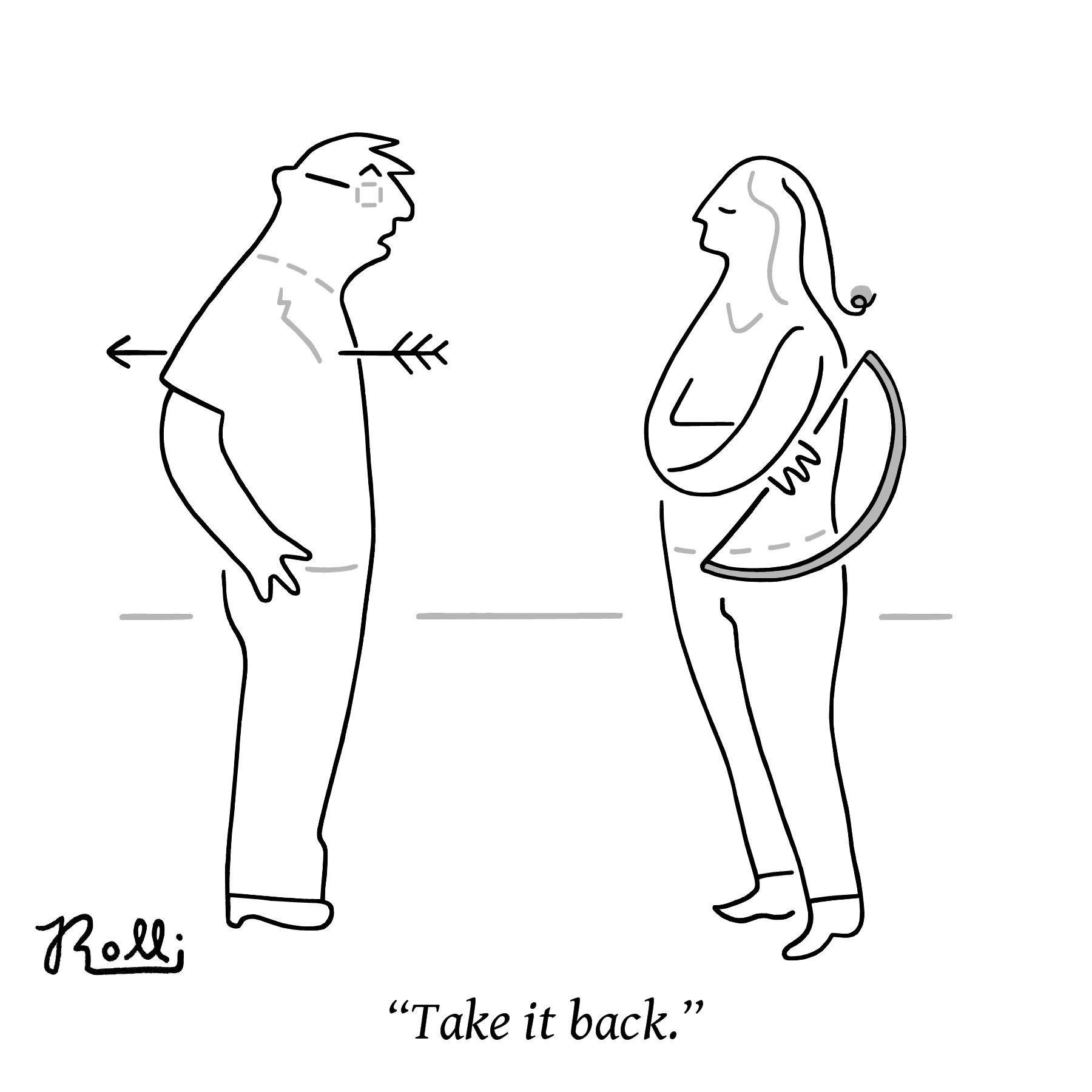
Have a great weekend!
Cheers – – –
Rolli
If you enjoyed this post, please consider buying me a coffee.
Mom was talking to the guy behind the fence. I wanted to walk in the corn in the garden.
“Oswald, you’ll get dirt on your trousers, your brand new trousers. You go sit on the steps.”
Mom said damn and rubbed her hands on her pants. The phone was ringing.
I walked in between the rows and rows of corn. Looking up at the sky.
I touched the fence and ran back. Touched it and ran back.
The guy behind the fence said: “I bet you can’t guess what’s in my van.”
I guessed something. That wasn’t it.
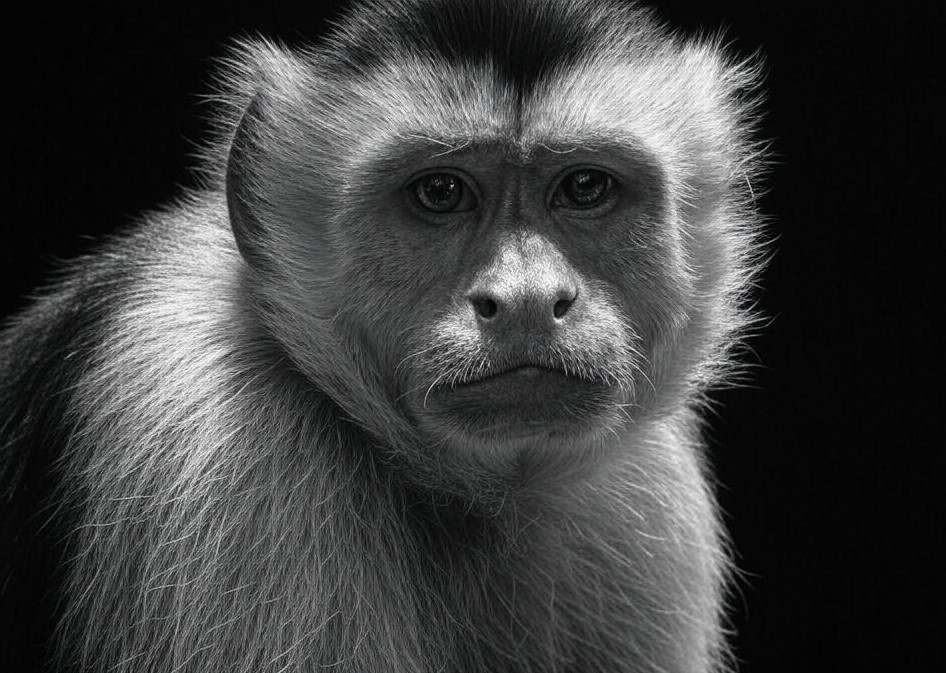
“No, it’s a capuchin monkey. You ever seen a capuchin monkey?”
I never did. He told me about it. It was brown with some white on its face. It had a collar on that said Kiss Me. I wanted to see it.
I climbed over the fence. The guy’s van was at the end of the alley. He opened the back doors and pulled some black curtains back.
There was just a wood box in the van. Right in the middle.
“He’s in that box, there. You go on in.”
I got in the van.
“I’ll close the doors so he don’t get out.”
The guy got in the van too and closed the doors and curtains.
It was dark in there.
The guy switched a light on, a flashlight. He shined it on the wood box. He opened up the box.
Something jumped out of the box. The guy shined a light on it but it was gone. It was on me. The guy put the light on me, on my shoulder.
It was a monkey. A capuchin monkey, like he said. Brown with some white on its face. I petted it. I felt the collar that said Kiss Me.
“Why don’t you kiss him?” said the guy. He was still shining the light.
I petted the monkey’s head and down its back and its tail. It had a curled tail.
“Why don’t you?”
“Nothing to be afraid of.”
“You can kiss him, if you like.”
“So why don’t you?”
Well, I picked the monkey up. I kissed it, quick.
The monkey didn’t like that. It bit me on my lip. It screamed.
The guy laughed. When he laughed the monkey got riled. It bit me again, right on my chin.
I dropped the monkey but it jumped back up. It bit my ear and scratched on my neck and my back.
The guy laughed and laughed. That made the monkey — it was jumping all over. It was wild. The guy shined the light on the monkey, wherever it went. It climbed everywhere. It climbed on me too, sometimes, and bit me again and scratched.
I swallowed my spit. There was blood in it.
The guy laughed and laughed.
“How do you like that?”
I didn’t say nothing. I just swallowed my spit.
The monkey screamed. It climbed up the curtains, to the bar on top.
The guy slapped his leg and laughed. He laughed and laughed. He kept the light on the monkey, on top of the bar. It walked back and forth, back and forth.
After a while up there, the monkey calmed down. It climbed back down. The guy called it but it crawled back on me. It just looked at me. It sat on my lap. It curled its tail around itself, like a cat. Then it sat there, quiet.
The guy stopped laughing. He grabbed the monkey by the collar. He took it and dropped it in the box and slammed the lid. Then he opened the curtains and the doors up.
“Go.”
That’s all he said.
The van took off and I ran back. Over the fence. Through the corn. Into the house.
When Mom saw me, she hung up the phone.
“Oswald, your trousers are filthy. That new shirt of yours is ripped. How on earth did you rip your brand-new shirt?”
I didn’t say nothing.
“Been climbing that fence again, haven’t you? Scratched yourself all up. The dirt you’re tracking in! Can’t stay out of that garden, either, can you?”
I didn’t say nothing.
“You better tell me the truth, Oswald. This minute.”
Mom got down and her eyes… Everywhere I looked, there they were. So I looked right at them and I told her. I told her everything.
“Oswald, I don’t want to hear it. I don’t believe a word of it. You and your stories. That nice man, with the white trousers? You ought to be ashamed of yourself. Really, Oswald. You and your stories.”
I wanted to say…
I didn’t say nothing.
“The shirt’s a write-off. The trousers I can mend. Really, you ought to be ashamed. Spoiling your clothes. Making up lies like that. Not a bit of that happened, did it, Oswald?”
I looked at my feet. I said: “Nothing happened.”
Mom got up.
“I didn’t think so. Now you go and get changed for dinner. You’re filthy.”
I went to my room and…
It didn’t happen. That’s what I said.
It did happen. It did.
It happened.
Something happened.
“A Capuchin Monkey” was first published in Transition and reprinted in Jerry Jazz Musician. It’s from my unpublished story collection Naked in a Graveyard. If you enjoyed it, kindly consider buying me a coffee.
 rollistuff.com